








US military action: Ohanaeze demands apology from New York Times, retraction of ‘falsehood’
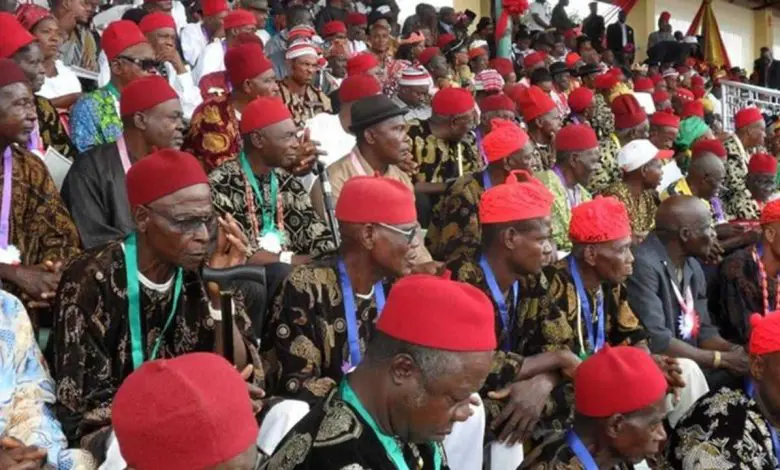

The apex Igbo socio-cultural organisation, Ohanaeze Ndigbo, has demanded an unreserved apology and retraction from the New York Times over a publication on U.S. military actions in Nigeria.
Ohanaeze stated, with unyielding clarity, that the Igbo people are neither participants in nor complicit with President Donald Trump’s campaign against terror networks and the alleged acts of Christian genocide in Nigeria.
While commending the ongoing partnership and collaboration between the United States and the Federal Government of Nigeria under President Bola Ahmed Tinubu, the pan-Igbo organisation said it was crucial to clarify that no Igbo individual contributed intelligence regarding the U.S. bombing of ISIS terrorists in Sokoto on Christmas Day 2025.
The group added that its concerns were heightened by the timing and manner of the New York Times’ publication, which suggested that an Onitsha-based screwdriver trader named Emeka provided intelligence to President Trump via U.S. channels.
This was contained in a statement issued on Tuesday by Ohanaeze’s factional Deputy President-General, Mazi Okechukwu Isiguzoro, and Chief Chinyereze Ohia, the National Spokesperson, and made available to journalists.
According to Ohanaeze Ndigbo, such claims appear to be a calculated attempt to implicate Ndigbo in actions aimed at Northern banditry associated with ISIS.
The organisation noted that, as a reputable newspaper, the New York Times should not allow itself to be misled by individuals, including Nigerian freelance photographer Taiwo Aina, to perpetuate what it described as an unfortunate anti-Igbo agenda.
“The assertion that a purported ‘screwdriver seller’ in Onitsha could be the architect behind U.S. military action is at once laughable and patently nonsensical.
“Such irresponsible reporting carries the risk of igniting ethnic rivalry and exacerbating tensions across Nigeria. Ndigbo will no longer serve as targets for scapegoating in narratives shaped by international media conspiracies reminiscent of the tumultuous period of 1966.”
Ohanaeze Ndigbo said it found it necessary to correct the record with utmost seriousness, stressing that the Igbo people are not the originators of petitions and narratives related to Christian genocide in Nigeria.
Although many Igbo people have fallen victim to these atrocities, it said it was imperative to recognise that numerous non-Igbo organisations and churches in the Northern region, along with diaspora pro-Christian and civil rights groups, are also actively championing the cause against Christian genocide.
“Why has the New York Times chosen to single out Emeka? What ulterior motives might be at play? Are U.S. lobbyists complicit in this narrative?
“It is crucial to state unequivocally that the Igbo people do not oppose the collaboration between the U.S. and Nigeria in combating terror groups, nor do we resist efforts aimed at improving Nigeria’s global image by U.S. lobbyists.
“However, this anti-Igbo international media conspiracy must cease, irrespective of the parties involved or the consequences they may face.
“The echoes of the 1966 pogrom against the Igbo people remain vividly fresh in our collective memory.
“We are acutely aware of the roles played by certain reputable international media in wrongly designating the Nigerian coup of January 15, 1966, as an ‘Igbo coup,’ which subsequently incited the counter-coup of July 1966.”
Ohanaeze noted that the narrative presented by the New York Times appears to follow a similarly dangerous trajectory, adding that since that era, the Igbo have been unjustly labelled as the source of Nigeria’s challenges.
Furthermore, the organisation urged all Igbo civil rights groups to refrain from commenting on security matters involving U.S.-Nigeria collaboration against ISIS and other banditry-related issues until the integrity of the Igbo community is fully restored.
US military action: Ohanaeze demands apology from New York Times, retraction of ‘falsehood’